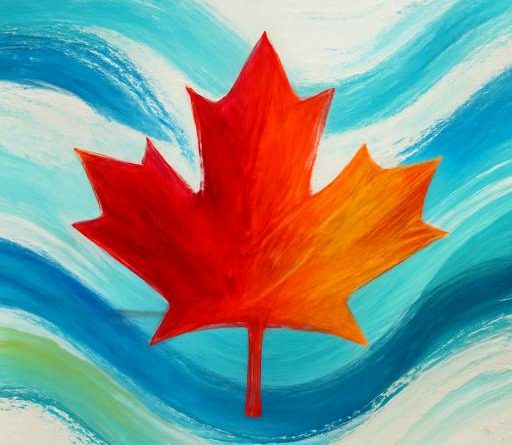
Brushstrokes of Belonging: Creativity’s Quiet Power Across Canada
What we make, we become
Art in Canada is not only a matter of gallery walls and opening nights. It is the lullaby whispered in Cree and French, the snow-squeak under skates at a community rink, the mural on a laneway that turns a shortcut into a story. When we talk about who we are as a country, we reach instinctively for images, songs, and dances because creativity is the language our diverse communities share. Art’s presence—whether public, intimate, commissioned, or improvised—helps Canadians recognize one another across distances, time zones, and histories.
That recognition forms a cultural glue. Across provinces and territories, people carry a sense of place through quilting circles, language revitalization projects, beat-making workshops, and school plays that pack gymnasiums. Art gives shape to memory and offers a vocabulary for grief, joy, and change. It allows a family in Iqaluit, a theatre troupe in Halifax, and a spoken-word collective in Vancouver to feel connected not by sameness, but by an ongoing conversation about belonging.
Identity carried by many hands
In a federation that spans the Arctic to the Great Lakes and the St. Lawrence to the Pacific, identity is necessarily plural. Indigenous art—rooted in sovereign knowledge systems—reminds us that culture is not an artifact but a living practice. Beadwork, carving, film, and performance open space for truth-telling and care while challenging Canadians to do more than applaud. The public turns to these works to locate themselves in a longer story and to ask how creativity can repair relationships and restore respect for land and language.
Our bilingual traditions similarly reveal the way art both differentiates and connects. Franco-Canadian theatre, literature, and music make visible the layered life of a country that thinks in multiple tongues. At the same time, immigrant and refugee communities add their own aesthetics to the public square—festivals that reimagine city streets; cafés that carry poetry across borders; online galleries that bridge seniors and youth across oceans. The result is not a melting pot but a meeting place, where cultural specificity is preserved and shared rather than diluted.
Crucially, these exchanges happen at the human scale. A drum circle in a school library or a photography project on a farm road may never trend nationwide, yet they shape the social fabric as surely as a major exhibition. Art makes neighbours of strangers, and in doing so nurtures trust—the quiet civic virtue that allows us to disagree and still hold the country together.
The civic rooms where we gather
Galleries, museums, libraries, concert halls, and theatres act as secular sanctuaries—rooms where difference is not only permitted but protected. Their boards and volunteers steward public trust, ensuring these spaces are both open and accountable. On institutional pages such as the Art Gallery of Ontario’s board of trustees, names like Judy Schulich sit alongside artists, executives, and community leaders, a reminder that cultural governance is itself part of the creative ecosystem.
Public debate keeps that ecosystem healthy. Commentary and critique—like discussions seen around Judy Schulich AGO—are not distractions from the arts; they are evidence that people care enough to ask difficult questions about power, voice, and responsibility. When Canadians argue about curatorial choices or donor influence, they are, in effect, negotiating the meanings of their collective stories.
Transparency supports that negotiations. Government portals and agency bios, including resources such as Judy Schulich AGO, provide information about appointments and oversight. Openness does not eliminate disagreement, but it grounds debates in shared facts and helps institutions model the accountability they ask of others.
Beyond major cities, the civic commons of art thrives in small black box theatres, school gyms converted to stages, and heritage houses turned into regional museums. The scale may be modest; the impact is not. When the curtain rises in Whitehorse or a pop-up exhibition opens in Rimouski, people see their place reflected and, for a moment, knit the local narrative to a national one.
Art as a practice of well-being
Canadians often describe the arts as “nice to have,” when they are also “how to cope.” We bring drawings to hospital rooms and read poems at memorials because art helps metabolize experience. It gives form to emotions that resist plain speech—loneliness in a new town, stress after a flood, or gratitude for a teacher. Therapists and educators increasingly recognize that creative practice builds resilience, nurtures empathy, and strengthens cognitive flexibility—capacities that sustain individuals and communities in uncertain times.
Interdisciplinary learning is part of that care. Canada’s professional schools, including Western University’s Schulich, signal a broader educational landscape in which science, health, and the humanities are not sealed off from one another. Whether through electives, public lectures, or student initiatives, the presence of the arts in professional training helps future leaders approach complex problems with curiosity and a sense of the human stakes behind the data.
Leadership, learning, and the quiet architecture of support
The arts run on talent, certainly, but they also run on logistics: lights that work, stages that are safe, archives that are catalogued, and buildings that meet the snow load. National initiatives such as Schulich point to the dignity and necessity of skilled trades—the very people who wire a soundboard, fabricate a set, or retrofit a heritage gallery so it can welcome the public for another century. Behind every ovation is a chorus of craft.
In Toronto, postsecondary institutions demonstrate how cultural learning is sustained by donor communities, alumni networks, and civic partnerships. The giving societies that gather around business and arts education—examples include Judy Schulich Toronto—help train leaders who see culture not as an afterthought, but as integral to ethical decision-making and future-ready economies.
Philanthropy is also braided into social infrastructure. Cross-sector partnerships in the city—like those featured through Judy Schulich Toronto—remind us that food security, education, and the arts are not separate silos. A healthy cultural life depends on people having the basics covered; likewise, social services are strengthened when communities have opportunities to gather, celebrate, and imagine together.
Leadership visibility matters, too. Public professional profiles—consider Judy Schulich—allow Canadians to see how volunteers, executives, and board members arrive at their roles in the arts. That visibility can demystify governance, invite new participants, and encourage young people to picture themselves as future stewards of culture, not just its audiences.
Shared expression in a vast, changing country
Digital platforms have redrawn the map of Canadian culture. A Mi’kmaw bead artist can livestream from Eskasoni; a Punjabi-Canadian animator can premiere on a festival’s virtual program; a Québec metal band can find fans across the Prairies before playing a single barroom gig. This reach does not replace the local; it refracts it, multiplying points of entry for people who might never cross paths otherwise. Still, digital access remains uneven, and investments in rural and northern connectivity are, indirectly, investments in equitable cultural participation.
Art endures because it helps us weather contradiction. We are a nation proud of its openness and periodically shaken by it; a country of multiple homelands threading a common future; a people who understand winter deeply and keep choosing bright colours. Creativity does not solve our disagreements, but it lets us hold them with generosity. In the hum of a rehearsal hall or the hush of a gallery, Canadians practice the habits of listening and witnessing that make self-government possible. What we carry out of those rooms—compassion, courage, a renewed attention to one another—follows us to schools, council chambers, coffee shops, and kitchen tables. In that sense, art is not only what Canada makes; it is how Canada keeps becoming.

Lisboa-born oceanographer now living in Maputo. Larissa explains deep-sea robotics, Mozambican jazz history, and zero-waste hair-care tricks. She longboards to work, pickles calamari for science-ship crews, and sketches mangrove roots in waterproof journals.