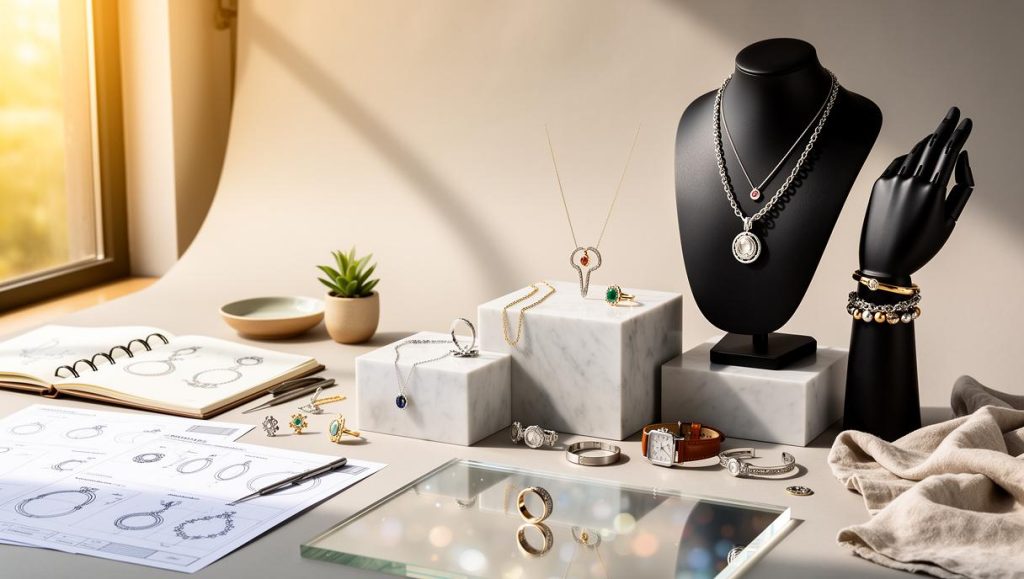
Crafting Visual Stories: Product Photography for Artisans That Sells and Inspires
Why artisan products need different photography than mass-market goods
Handcrafted work carries a signature that factories cannot replicate: the brush stroke on a ceramic bowl, the grain in a hand-stitched leather wallet, the micro-facets of a gemstone, the patina on a bronze clasp. Product photography for artisans must do more than record an object; it should translate these tactile qualities into images that evoke touch, trust, and value. While mass-market items lean on uniformity, artisans win with authenticity—yet that uniqueness can be hard to communicate online without a considered visual approach.
Great images reduce hesitation and return rates because shoppers can “feel” the product through detail-rich, true-to-color pictures. For jewellery and watches, macro-friendly clarity and controlled reflections are essential; for textiles, wood, and ceramics, directional light reveals texture and craftsmanship. The goal is to balance editorial allure with commercial clarity. Think of a set that includes a clean packshot on pure white for marketplaces, a lifestyle vignette that conveys use and scale, and, where relevant, an on-model frame to show proportion, drape, or wrist presence. This trio helps buyers visualize context while retaining accuracy.
Consistency is another pillar. Artisans often release small-batch collections over time; consistent angles, horizons, backgrounds, and color renderings unify the catalog so a studio-grown brand identity emerges. This is crucial on platforms like Etsy and Shopify, as well as social channels where grids and carousels rely on visual rhythm. Consider specifying a minimum of 2000–3000 px on the long edge for web, with additional 2K or 4K masters for zoom functionality and print collateral like line sheets or postcards. Color-managed workflows—shooting RAW, setting white balance with a gray card, and profiling displays—protect your palette, which is vital when your value lies in material choice and finish.
Modern, AI-assisted production has also reshaped the equation. Instead of months of location scouting and prop sourcing, artisans can generate cohesive backdrops, adjust lighting mood, and produce multiple variations quickly, keeping pace with new releases. This accelerates content for lookbooks, seasonal campaigns, and rapid A/B testing—without sacrificing the craft-forward story your audience expects.
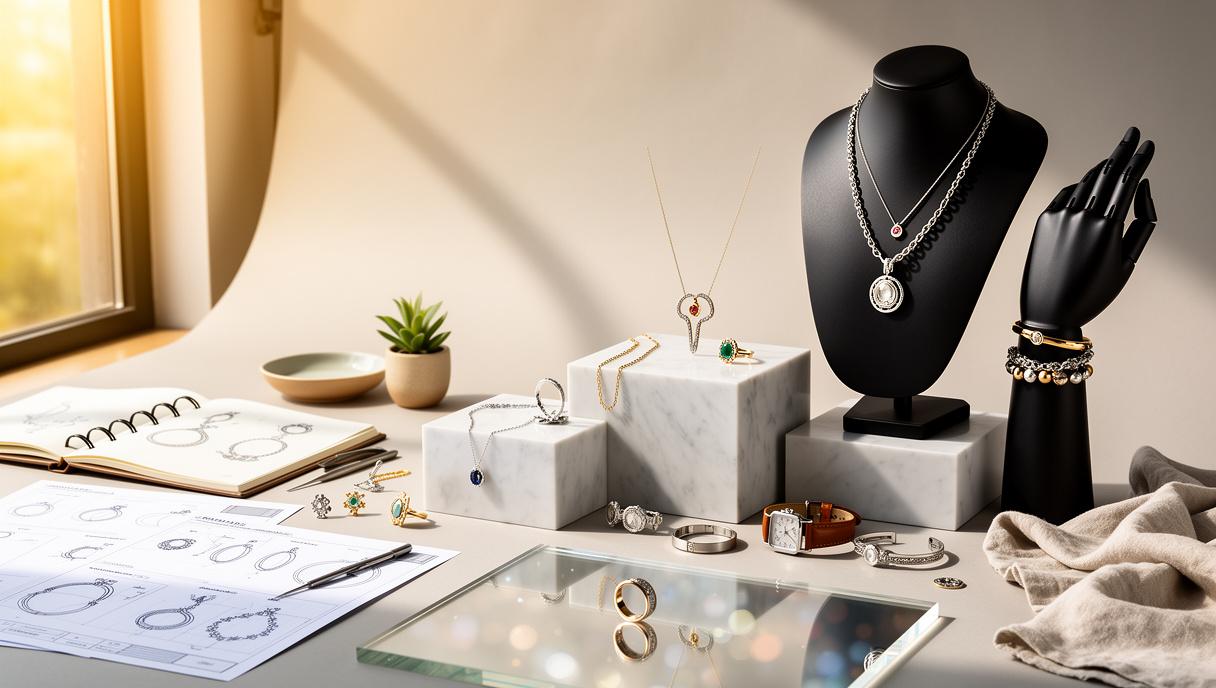
Lighting, styling, and technical choices that honor materials and craft
Every material photographs differently, so lighting must be customized to flatter the build of each object. Metals and gemstones demand large, diffused sources to create elegant gradients and controlled highlights. A light tent or broad softbox wrapped close to the piece yields smooth reflections; negative fill (black cards) adds shape and contrast, preventing a flat look. For gemstones, add a small, harder accent (a snoot or grid) to wake up brilliance without blowing out facets. Cross-polarization—using a polarizing filter on the lens and a matching film on lights—can tame glare on polished surfaces while preserving saturation.
Ceramics, wood, textiles, and leather benefit from directional side light to reveal texture. Angle your key light 30–60 degrees from camera, and use a white fill card opposite to soften shadows. A simple three-point approach—key, gentle fill, and a subtle back or rim light—creates depth on neutral backgrounds. Maintain modest contrast for e-commerce clarity, then increase mood for lifestyle frames that show function: a ceramic mug with rising steam near a window, a leather bag against natural linen, a carved spoon beside fresh herbs.
Lens and camera choices matter. Macro primes in the 90–105mm range keep working distance comfortable while capturing fine details. Shoot at f/8–f/16 for crispness, and consider focus stacking for ultra-small items like rings or watch crowns. Tethered capture helps evaluate dust, micro-scratches, and alignment; a rocket blower, anti-static brush, and microfiber cloth are indispensable. For watches, set hands to the classic “10:10” to frame the logo and subdials; for necklaces, smooth kinks and align pendants with a fishing line or wax. Use seamless sweeps in white, gray, or black acrylic and keep horizons consistent across SKUs.
Color is integral to trust. Use a gray card to set white balance and, if available, a color chart for profiling. Shoot RAW to preserve latitude. Export sRGB JPEGs for web and high-resolution TIFFs or PNGs for print. Maintain clean edges when removing backgrounds; add subtle, realistic shadows to prevent cutout “sticker” vibes. Finally, build a repeatable checklist: dust check, alignment, hero angle, secondary angles (front, 45°, side, back, macro), scale reference (a hand, coin, or on-model), and packaging shots. This creates an efficient, artisan-centric standard that elevates every launch.
Scaling artisan visuals: workflows, AI-powered studios, and real-world scenarios
A successful visual system starts with a plan. Create a style guide covering background tones, lighting mood, reflections, horizon height, and cropping. Then write a shot list per SKU: hero, three-quarter, side/back, macro detail, lifestyle context, and on-model (if applicable). Standardize file naming (brand_collection_sku_view01) to keep sets organized. Batch edits for exposure and white balance safeguard consistency, while subtle per-image refinements handle the quirks of handcrafted items. Deliver multi-ratio crops for different channels: square for marketplaces, 4:5 for Instagram feeds, 16:9 for web banners, and high-res portraits for print.
AI-enabled visual studios help artisans move from idea to image rapidly. With drag-and-drop scenes and intelligent masking, you can test backdrops—marble slab, artisan workbench, minimalist concrete—without set-building. Need an on-model frame to show earring drop length or a bracelet stack? Generate a realistic composition, match shadows and reflections, and iterate outfits or skin tones to target different audiences. For launches, produce coordinated assets—packshots for the shop, lifestyle images for social, and elevated campaign key visuals—while keeping materials, finishes, and scale faithful to the original. Platforms like Canova bring this to life with fast, high-fidelity outputs suitable for web and print, allowing small ateliers to operate with big-brand polish.
Consider two scenarios. First, a silversmith in Barcelona preparing a 60-piece drop: instead of booking multiple studio days, they plan a tight shot list, capture a core set of angles in RAW, and then leverage an AI studio to generate seasonal lifestyle backdrops (warm Mediterranean hues for summer, cool terrazzo for winter). They ship within a week, see a 27% lift in click-through on hero images, and a measurable dip in returns due to clearer macro details. Second, a ceramicist in Portland with an upcoming market needs fast volume: a single lighting setup with consistent side light captures packshots, while AI-generated context scenes—breakfast table, open shelving—fill social queues for a month without reshoots.
Local realities don’t have to be limiting. Whether working in a London flat, a Mumbai workshop, or a small-town studio, remote-friendly workflows let artisans compete globally. No access to a stylist or prop library? Generate options digitally, auditioning palettes and surfaces that align with your brand story. Need 2K and 4K imagery for a new webshop and printed lookbook? Render multiple versions from a single master. A/B test hero images on your homepage, alt-text them with material keywords for SEO, and carry the same lighting logic into short videos or stop-motion for reels. If you’re ready to modernize your process without losing the human touch, explore Product photography for artisans to build a scalable, craft-first visual engine that keeps pace with your imagination.

Lisboa-born oceanographer now living in Maputo. Larissa explains deep-sea robotics, Mozambican jazz history, and zero-waste hair-care tricks. She longboards to work, pickles calamari for science-ship crews, and sketches mangrove roots in waterproof journals.